

From Repetition To Mastery: The Power Of Kata

Kata: The Foundation of Traditional Karate
In today's martial arts world, kata is often misunderstood. To the untrained observer, it may appear to be a series of choreographed movements, rigid poses, and repetitive drills that bear little resemblance to "real fighting." Some critics dismiss kata as outdated or unnecessary, believing that sparring alone is the best path to becoming an effective martial artist.
Those who have dedicated years—or even decades—to traditional karate understand a different truth.
Kata is not a relic of the past. It is the foundation upon which effective karate is built.
What Is Kata?

The word "kata" refers to a prearranged sequence of techniques that has been passed down through generations of karate practitioners. Each kata contains strikes, blocks, kicks, footwork, body positioning, transitions, and defensive concepts that represent the fighting principles of the art.
At the beginner level, students often learn kata as a sequence of movements. They focus on memorizing patterns, improving coordination, and understanding basic techniques.
As a student's experience grows, so does their understanding of the kata.
What once appeared to be a simple block may reveal itself as a joint lock, a takedown, or a close-range defensive maneuver. A movement that seemed straightforward in the beginning may contain multiple applications and layers of meaning.
In this way, kata becomes a lifelong teacher.
Why Repetition Matters
Many people question why karate students practice the same kata repeatedly.
The answer can be found in virtually every high-level athletic pursuit.
A professional golfer does not stop practicing their swing after learning the fundamentals. They may perform the same motion thousands of times throughout their career, constantly refining body mechanics, precision, timing, and consistency.
Likewise, an elite basketball player never outgrows practicing free throws. Despite performing at the highest level of competition, they continue to refine the fundamentals because mastery is found in repetition.
Karate is no different. Every repetition of kata develops balance, posture, body control, coordination, focus, and precision. Through repetition, movements become smoother, more efficient, and more powerful.
Most importantly, repetition creates familiarity.
When techniques are practiced consistently over time, they become available without conscious thought. The body learns to respond instinctively rather than hesitating to decide what to do next. This is one of the primary goals of traditional martial arts training.
Building Proper Mechanics
A common mistake among beginners is believing that power comes from strength alone.
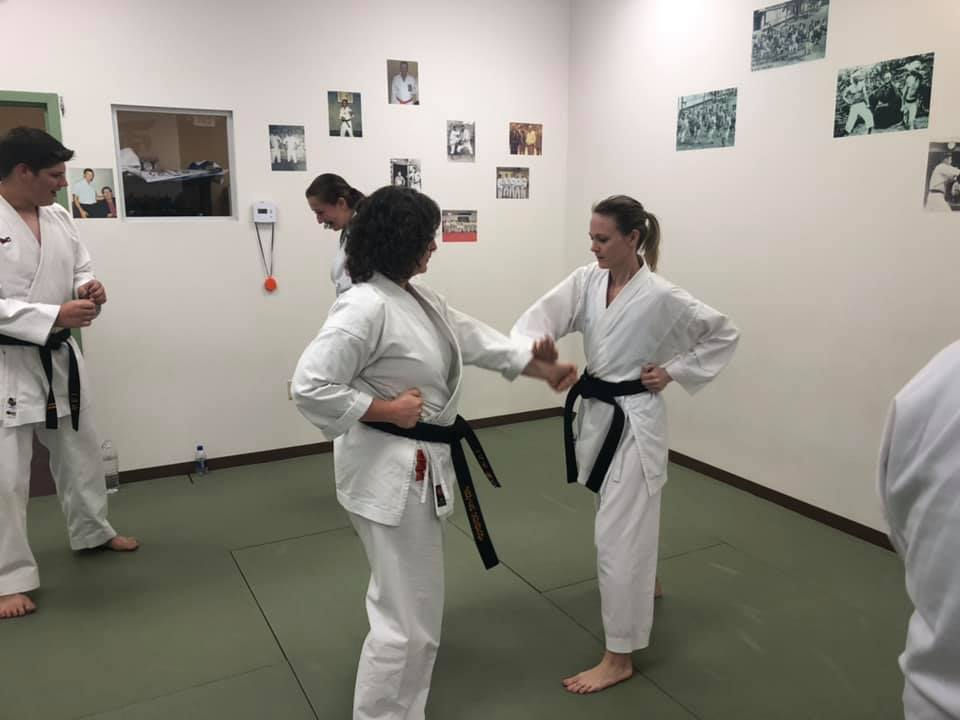
In reality, effective karate relies heavily on proper body mechanics. Kata teaches students how to generate power from the ground, transfer energy through the hips, maintain structural integrity, and deliver techniques with efficiency. It develops balance during movement, stability during impact, and proper alignment throughout each technique.
Without these foundations, techniques often become inefficient, slower, and less effective.
Just as a golfer develops a reliable swing and a basketball player develops a repeatable shooting motion, the karate practitioner develops dependable movement patterns through kata. The result is not robotic movement but improved body mechanics that support effective application.
Kata and Kumite: Partners, Not Opposites

One of the greatest misunderstandings in martial arts is the belief that kata and kumite are somehow opposing forms of training. In reality, they complement one another.
Kumite, or sparring, allows students to test timing, distance, adaptability, strategy, and the application of techniques against a resisting opponent. It develops reaction skills and helps students learn how to apply their training in a dynamic environment and it encourages the critical thinking skills that help to develop a sharp mind to notice movements as an attacker approaches. It's the game designed around karate to help develop a practitioner's reflex and response to an oncoming opponent.
Kata serves a different purpose. Kata develops the tools that make effective application possible. It refines technique, reinforces proper mechanics, improves body awareness, and preserves the principles that form the foundation of karate. Without kata, sparring can become little more than athletic movement without technical depth. It helps the practitioner develop a calm focused mind with an attention to detail.
Although these training methods seem to be opposites, a student learns to be a well rounded martial artist as they gain understanding of both.
The Study of Bunkai
As students advance, they begin exploring bunkai—the practical applications hidden within kata movements. This is where many practitioners discover that kata contains far more than basic punches and blocks.
Within the movements are concepts involving self-defense, joint manipulation, close-range striking, takedowns, off-balancing techniques, trapping, and controlling an opponent's movement. The deeper a student studies, the more they realize that kata is not merely a collection of techniques. It is a record of accumulated martial knowledge passed down from previous generations. A beginner may see a movement. An experienced practitioner sees a principle, and a master may see multiple applications hidden within the same motion. This ongoing discovery is one of the reasons kata remains relevant throughout a practitioner's entire martial arts journey.
A Lifetime of Learning
Unlike many physical activities that eventually become routine, kata continues to evolve as the practitioner evolves. Although a student may perform the same kata for twenty years long time martial artists all agree that they still discover new insights, even after decades of training the same set of kata. Changes in experience, physical ability, understanding, and training methods often reveal lessons that were previously unnoticed.
This is why kata is often described as a lifelong study. The movements themselves remain the same, but the practitioner's understanding deepens over time.
The Heart of Traditional Karate
Kata is not a waste of time, and it definitely isn't an outdated practice preserved simply for tradition's sake. Kata is a training method designed to develop precision, focus, balance, coordination, body mechanics, and fighting principles through disciplined repetition.
The karate practitioner who dedicates themselves to kata is not merely learning a sequence of movements. They are building a foundation that allows techniques to become natural, efficient, and readily available when needed.
While kumite teaches adaptation and strategy, kata develops the tools that make effective application possible. For generations, kata has shaped skilled martial artists. It remains one of the most valuable training methods in traditional karate because its lessons never truly end.
Long after a student has memorized the movements, kata continues to teach.


Comments